 99268 21000
 99268 21000
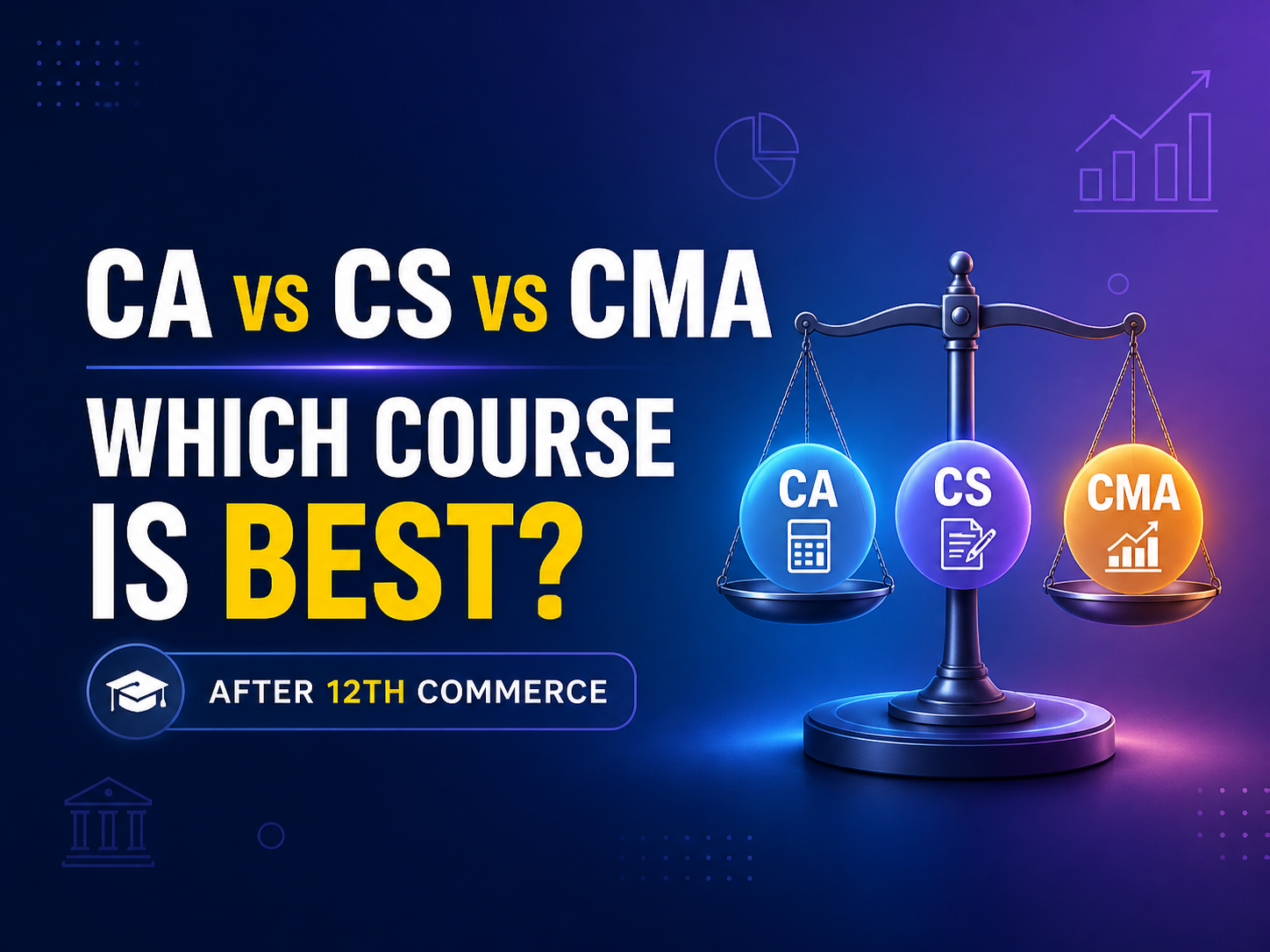
CA vs CS vs CMA — Which Professional Course is Best After 12th Commerce?
A student-friendly, honest comparison to help you choose the right career path in 2026
Every year, thousands of 12th Commerce students across India face the same big question: CA, CS, or CMA — which one should I choose? Each course leads to a prestigious professional designation, but they differ vastly in career scope, difficulty, salary, and industry demand. This guide breaks it all down with clear data and zero jargon — so you can make an informed decision that actually fits your strengths and goals.
Quick Answer
Choose CA for highest earning potential in finance & taxation. Choose CS for corporate law & governance with less competition. Choose CMA for cost management roles in PSUs & manufacturing. All three can be started right after 12th — no degree needed.
📋 Table of Contents
Quick Overview: CA, CS & CMA
Before diving into comparisons, here's what each qualification actually means — and who it's designed for.
CA
Chartered Accountant · ICAI- Auditing & taxation expert
- Works with Big 4 firms
- CFO-level roles at top corporates
- Can open own CA practice
- Most prestigious finance credential
CS
Company Secretary · ICSI- Corporate law & compliance
- Mandatory in every listed company
- Corporate governance specialist
- SEBI, MCA & ROC filings
- Less competition than CA
CMA
Cost Management Accountant · ICMAI- Cost & management accounting
- High demand in PSUs
- Steel, pharma & manufacturing
- Budget & financial control roles
- Faster completion than CA
Side-by-Side Comparison Table
A complete look at the key parameters across all three professional courses — scroll right on mobile to see all columns.
| Parameter | CA | CS | CMA |
|---|---|---|---|
| Governing Body | ICAI | ICSI | ICMAI |
| Eligibility | After 12th (Any stream) | After 12th (Any stream) | After 12th (Any stream) |
| Course Duration | ~3.5 years / 42 months (New Scheme 2024) | 3–4 years | 3–4 years |
| Total Levels | 3 (Foundation, Inter, Final) | 3 (Foundation, Executive, Professional) | 3 (Foundation, Inter, Final) |
| Articleship / Practical Training | Yes — 2 years (New Scheme 2024; starts after clearing both Inter groups) | Yes — 21 months (ICSI Training Guidelines 2024) | Yes — 15 months (ICMAI New Practical Training Scheme 2020) |
| Difficulty Level | ⭐⭐⭐⭐⭐ Hardest | ⭐⭐⭐ Moderate | ⭐⭐⭐⭐ Hard |
| Foundation Pass Rate | ~30–35% | ~40–50% | ~35–45% |
| Registration Fees | ~₹30,000–40,000 | ~₹20,000–30,000 | ~₹20,000–25,000 |
| Starting Salary | ₹6–10 LPA | ₹4–7 LPA | ₹4–6 LPA |
| Senior-Level Salary | ₹30–80 LPA | ₹15–40 LPA | ₹12–30 LPA |
| Parallel with B.Com? | Yes (Foundation level) | Yes (Foundation level) | Yes (Foundation level) |
| Job Market Demand | Very High | High | High (PSU / Mfg) |
Career Scope & Job Roles
Understanding where each qualification takes you is crucial before committing years of effort. Here's where each professional works and what they do.
📊 Chartered Accountant (CA) — Where Can You Work?
Big 4 firms (Deloitte, PwC, EY, KPMG), banks, NBFCs, listed corporates, government departments, and independent CA practice. Key roles include Statutory Auditor, Tax Consultant, CFO, Finance Manager, and Internal Auditor.
⚖️ Company Secretary (CS) — Where Can You Work?
Every listed company is legally required to have a full-time CS. Roles include Company Secretary, Legal Advisor, Compliance Officer, Corporate Governance Head, and Stock Exchange Advisor — a great path for those who love corporate law.
📈 CMA — Where Can You Work?
Manufacturing companies, PSUs (SAIL, ONGC, BHEL), banks, and consulting firms. Roles include Cost Accountant, Budget Analyst, Financial Controller, and Management Consultant — with high demand across steel, pharma, and infrastructure sectors.
Salary Expectations in India (2025–26)
Salary depends on your qualification level, city, and employer. Here's a realistic picture for freshers and senior professionals.
| Experience Level | CA Salary | CS Salary | CMA Salary |
|---|---|---|---|
| Fresher (0–2 yrs) | ₹6–12 LPA | ₹4–8 LPA | ₹4–7 LPA |
| Mid Level (3–7 yrs) | ₹15–30 LPA | ₹8–18 LPA | ₹8–15 LPA |
| Senior (8 yrs) | ₹30–80 LPA | ₹20–45 LPA | ₹15–30 LPA |
| Own Practice / Partner | Unlimited | ₹20–60 LPA | ₹15–40 LPA |
Which Course is the Hardest?
The honest answer: CA is the toughest of the three, followed by CMA, then CS. But "hard" doesn't mean "impossible" — lakhs of students clear CA every year with the right guidance and coaching.
Why CA is Considered Hard
- Low pass rates (~30–35% at Foundation level)
- 6 papers at the Intermediate level (reduced from 8 under ICAI New Scheme 2024)
- Mandatory 3-year practical articleship
- Final exams are highly conceptual and application-based
- No fixed cap on number of attempts
Final Verdict — Which Should YOU Choose?
There is no single "best" course — it depends on your personality, interests, and long-term career vision. Use these profiles to identify the right fit.
Choose CA if…
You love numbers, taxation, and finance — and are ready to work hard for 4–5 years for the highest earning potential.
Choose CS if…
You enjoy corporate law and compliance, and want a clear corporate career path with lower competition than CA.
Choose CMA if…
You're interested in cost management and PSU jobs, or prefer a slightly faster qualification with great industry scope.
Ready to Start Your Journey?
Excel Educational Institute, Raipur offers expert coaching for CA, CS & CMA — with Chhattisgarh's highest pass rates, available in Hindi & English medium.
Enquire About Admissions →
.jpeg)